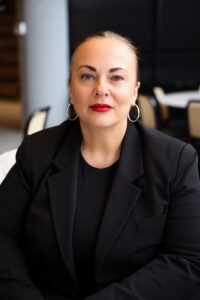
Pattie spent four years in prison and two years on parole. Her story is one of resilience, transformation and the power of learning to shape new possibilities.
 When people hear that I have lived experience of the justice system, they often expect a story about what went wrong. I prefer to talk about what went right. For me, so much of what went right started with learning.
Being seen as capable
My turning point was RMIT University’s Inside-Out Prison Exchange Program. Inside-Out brings university students and people in custody together to learn side by side, as equals, in the same room. Being part of it was transformative. My ideas were taken seriously. I was not defined by my worst moment, but by what I had to contribute. And the learning went both ways. Students often came into the prison carrying their own assumptions about the people inside, and those assumptions were challenged too.
That is what made the biggest difference to my learning: being treated as capable. Too often, education in the justice system happens in spaces built for compliance rather than curiosity. What kept me going were people who believed I could do more, and opportunities that matched that belief.
Hope Network was one of those places. Over more than 10 years, I went from participant, to volunteer, to paid staff. Each step built the confidence I needed for the next one. Along the way I worked as a Peer Worker with Australian Community Support Organisation’s ReConnect program, and today I am completing a Bachelor of Arts in Criminology. There was a time I never thought any of this would be possible.
Learning gave me a voice
Education gave me more than a qualification. It gave me language for my own experience, and the confidence to use it in rooms where decisions are made about women like me.
Today I coordinate Hope Network’s Lived Experience Advisory Panel, I am Associate Director of the Beyond the Stone Walls Advisory Collective, and I speak with policymakers, funders and service providers. None of that happened because the system suddenly changed. It happened because people believed in me before I believed in myself, and because learning changed how I saw myself. That changed what I was willing to try.
What I have learned along the way
The first lesson is that learning is not linear. Life gets in the way, especially for women juggling housing, family, health and the conditions of their release. A pause is not a failure. Programs that let people step out and come back again are the ones that work.
The second is that relationships come first. Nobody learns well from someone who sees them as a risk to be managed. Trust is the foundation, and it takes time.
The third is about how we describe the women we support. They are often labelled as having “complex needs”. I have come to challenge that. The women I work with are not complex. Their needs intersect: housing, income, health, family, education. And they are navigating systems that rarely talk to each other. When we place the complexity in the woman, we lower our expectations of her. When we place it in the systems, we start asking what needs to change.
How educators can help
If you work in adult and community education, here is what I would ask of you:
- Start before release. Learning in custody should connect to a real pathway outside, with the same provider or a warm handover, so momentum is not lost at the gate.
- Build in flexibility. Rolling enrolments, recognition of prior learning, and room to pause and return make the difference for women whose lives are still settling.
- Remember the basics. A woman who does not know where she will sleep tonight cannot focus on a module. Education works best alongside housing and practical support, not instead of it.
- Involve people with lived experience. We know what helps because we have lived it. Bring us into the design and delivery of programs and pay us for that expertise.
- Hold high expectations. Believe in people’s potential and let them see that you do. It may be the first time anyone has.
A voice to be heard
Learning brought me home in more ways than one. It helped me find my way back to community, and back to a version of myself I had almost given up on.
If you are an educator wondering whether your work makes a difference for people in and beyond the justice system, it does. I am proof of that, and so are many of the women I walk alongside every day.
Pattie is now the Community & Stakeholder Engagement Coordinator at the Hope Network and was an Adult Learners Week 2026 Ambassador.
Included in Categories


Pattie spent four years in prison and two years on parole. Her story is one of resilience, transformation and the power of learning to shape new possibilities.
Being seen as capable
My turning point was RMIT University’s Inside-Out Prison Exchange Program. Inside-Out brings university students and people in custody together to learn side by side, as equals, in the same room. Being part of it was transformative. My ideas were taken seriously. I was not defined by my worst moment, but by what I had to contribute. And the learning went both ways. Students often came into the prison carrying their own assumptions about the people inside, and those assumptions were challenged too.
That is what made the biggest difference to my learning: being treated as capable. Too often, education in the justice system happens in spaces built for compliance rather than curiosity. What kept me going were people who believed I could do more, and opportunities that matched that belief.
Hope Network was one of those places. Over more than 10 years, I went from participant, to volunteer, to paid staff. Each step built the confidence I needed for the next one. Along the way I worked as a Peer Worker with Australian Community Support Organisation’s ReConnect program, and today I am completing a Bachelor of Arts in Criminology. There was a time I never thought any of this would be possible.
Learning gave me a voice
Education gave me more than a qualification. It gave me language for my own experience, and the confidence to use it in rooms where decisions are made about women like me.
Today I coordinate Hope Network’s Lived Experience Advisory Panel, I am Associate Director of the Beyond the Stone Walls Advisory Collective, and I speak with policymakers, funders and service providers. None of that happened because the system suddenly changed. It happened because people believed in me before I believed in myself, and because learning changed how I saw myself. That changed what I was willing to try.
What I have learned along the way
The first lesson is that learning is not linear. Life gets in the way, especially for women juggling housing, family, health and the conditions of their release. A pause is not a failure. Programs that let people step out and come back again are the ones that work.
The second is that relationships come first. Nobody learns well from someone who sees them as a risk to be managed. Trust is the foundation, and it takes time.
The third is about how we describe the women we support. They are often labelled as having “complex needs”. I have come to challenge that. The women I work with are not complex. Their needs intersect: housing, income, health, family, education. And they are navigating systems that rarely talk to each other. When we place the complexity in the woman, we lower our expectations of her. When we place it in the systems, we start asking what needs to change.
How educators can help
If you work in adult and community education, here is what I would ask of you:
A voice to be heard
Learning brought me home in more ways than one. It helped me find my way back to community, and back to a version of myself I had almost given up on.
If you are an educator wondering whether your work makes a difference for people in and beyond the justice system, it does. I am proof of that, and so are many of the women I walk alongside every day.
Pattie is now the Community & Stakeholder Engagement Coordinator at the Hope Network and was an Adult Learners Week 2026 Ambassador.
Included in Categories